


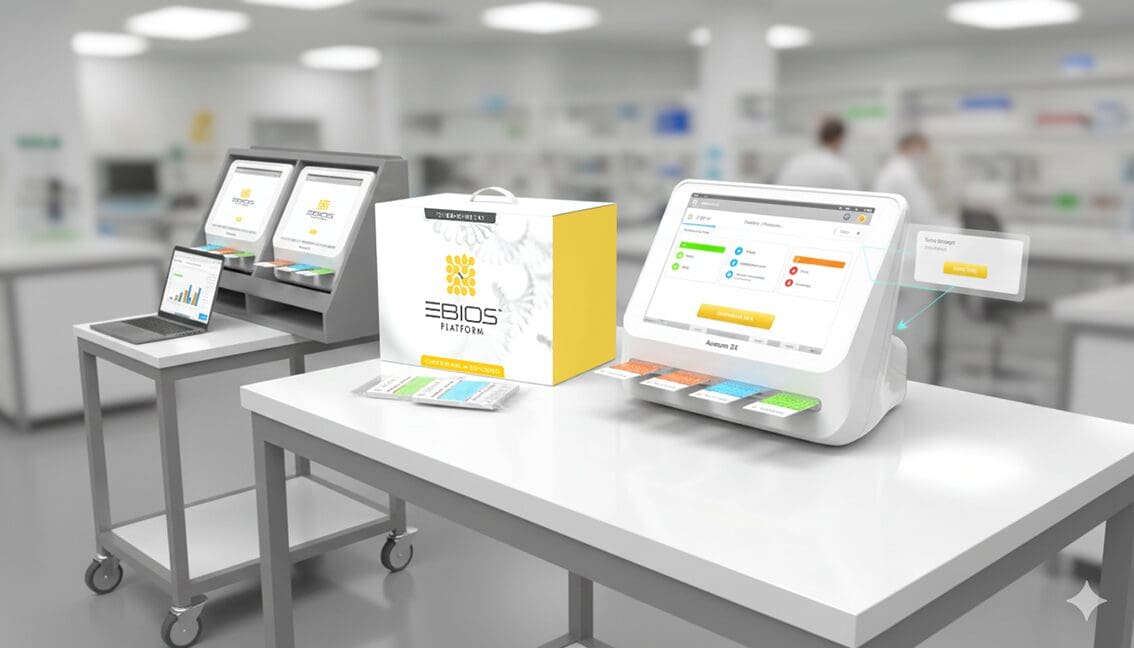


We recently had the opportunity to sit down with Tessa Ogle, CEO of Aureum Diagnostics, for an exciting conversation about the company’s rapid growth, groundbreaking biosafety technology, and bold vision for the future. With four innovative solutions in development and strong industry partnerships, Aureum is quickly establishing itself as a leader in biosafety. Their unique approach and expanding platform have the potential to transform not only biosafety monitoring, but a wide range of industries.
What is the exit plan for Aureum?
“We believe as soon as Aureum has two biosafety products on the market we will have a strong chance of an exit. The plan is to wait for the second product because that is the moment of maximum certainty. You aren’t just selling a company; you are selling a “revenue machine” that has already done the hard work of the one-year negotiation and has a clear, contractually obligated path for the following two years. For an acquirer, that’s a very easy cheque to write.”
What other markets could your technology impact?
“One of the attractive elements of the Aureum Technologies approach is that the innovations we are making have applicability across a range of industries and in essence can be applied to any testing challenge where the goal is to measure a chemical or biological target.
Conversations with interested parties have included: (i) implementing a newly developed and highly innovative endotoxin testing reagent onto our platform, (ii) using the platform for enhancing the diagnosis of sepsis, (iii) adapting the platform for the mining sector by measuring cyanide and phenols in waste and ground water, (iv) the food sector including listeria/salmonella detection and measurement of adulterants in food, and (v) general water testing, including pollutants, toxins and microbial contamination with interested parties being utilities providers, pharmaceutical companies and regulators.”
Who are Aureum’s main competitors?
“One of the attractive elements of Aureum’s strategy is that the application of electrochemical sensing approaches to biosafety is unique. Most early-stage electrochemistry ventures target human health, a much more challenging area to gain traction in. What is more, biosafety as a sector has not seen transformational technological change for three decades, with most providers of testing relying on laborious optical plate-based assays. This means the company is well placed to launch products in biosafety and then rapidly pivot into other markets before any potential competitors would be in position to catch up. From an acquisition perspective, this makes Aureum a very attractive prospect.”
What are the next steps?
“The intention is to trial the first assay during 2026. After attending and presenting the Aureum platform at Pharmalab 2025, Aureum developed significant traction with other leading biosafety companies and a major activity of 2026 will be converting the interest into new projects and relationships.”
What are the most compelling reasons to be excited about Aureum’s future?
“Electrochemical biosensors have long held promise because they are low-cost, robust, highly sensitive and potentially very easy to use. Since the development of the home blood glucose test in the late 1980s and early 1990s there has not been much breakthrough from new companies with new products. This is because measurement of low concentration biomarkers in complex samples is extremely challenging. By focussing on biosafety, where target analytes are present at higher levels and in cleaner samples, Aureum can take the next step and release electrochemical systems into biosafety. Beyond that, once biosafety is established, using our hard won knowledge of how to build these systems and how to measure in complex samples we will then move on to address a number of other, attractive markets. Breaking through into biosafety testing with a novel electrochemical platform will be a significant step forward for the field of biosensing and will gain significant recognition for the company.”


